Herzog Tasks Eisenkot With Forming Government
The Israeli president selected Gadi Eisenkot over Benjamin Netanyahu after a 67 to 46 vote among lawmakers following the October 27 election.
By Carolina Wood ·
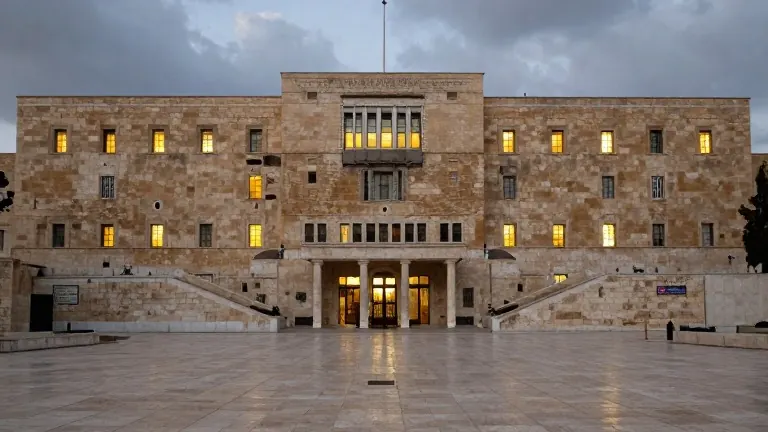
Israel is entering a new political phase as President Isaac Herzog has assigned the task of forming a coalition to Gadi Eisenkot. This decision effectively sidelines current Prime Minister Benjamin Netanyahu after the October 27 general election failed to produce a clear winner. Herzog informed Eisenkot of his selection on Saturday evening. A formal ceremony to present the mandate is scheduled for Sunday.
The choice was determined by a count of recommendations from members of the Knesset. A total of 67 lawmakers endorsed Eisenkot, the leader of the Yashar party. This group included representatives from Arab-led parties. In contrast, only 46 lawmakers supported Netanyahu. Eisenkot now has a 28-day window to assemble a governing majority. He may receive a 14-day extension if necessary. The target is a coalition of at least 61 seats in the 120-seat parliament.
The October election results left the legislature divided. Eisenkot’s four-party alliance claimed 48 seats. Netanyahu’s bloc of right-wing and religious parties secured 53 seats. Both groups fell short of the 61-seat threshold required to govern independently. Arab-led parties, which represent Palestinian citizens of Israel, won a record 19 seats. Eisenkot has stated that he does not intend to include these parties in the cabinet. Their support would technically provide a 67-seat bloc, but he prefers a different structure.
Eisenkot’s path to a majority relies on winning over the two ultra-Orthodox parties, United Torah Judaism and Shas. Their support would bring his total to exactly 61 seats. Alternatively, he could form a smaller government with fewer than 61 seats if he passes a parliamentary confidence vote. If Eisenkot fails to build a viable government within the allotted time, Herzog will nominate a second candidate. If that candidate also fails, a parliamentary majority can support a third nominee for a final 14 days. If all attempts fail, a new election will be called within 90 days. Netanyahu will remain as caretaker prime minister in that scenario.
Gadi Eisenkot served as Israel’s military chief from 2015 to 2019. He was an observer in Netanyahu’s war cabinet for the first eight months of the war in Gaza, which began in October 2023. Ahmad Tibi, a senior member of the Joint List, described the president’s decision as expected. The Joint List is a coalition of Arab-led parties holding 11 seats. Tibi expressed concern that Herzog might have pursued a national unity government involving power sharing with Netanyahu. Instead, the Arab-led parties granted Eisenkot a considerable margin of support.
Tibi believes Eisenkot is moving toward a minority government that will rely on external support from the Arab parties. He acknowledged this is not the ideal outcome for his group. However, he prioritized the goal of ending the government led by Netanyahu, Itamar Ben-Gvir, and Bezalel Smotrich. Tibi noted that the decision allows for a break from the current leadership structure. The new administration must balance campaign promises while surviving opposition from the right-wing bloc.
Hours before the announcement, Netanyahu warned that a government dependent on Arab-led parties would lead to the state’s collapse. In a prerecorded video, he argued that such a government, reliant on Islamists, would dismantle Israel from within. Tibi responded by calling Netanyahu the biggest terrorist in Israel and the region. He cited the prime minister’s support for what he termed Jewish terrorism in the West Bank and Palestinian territories. Tibi stated that Netanyahu described his supporters as backers of terrorists and terrorism.
Nour Odeh, reporting from Ramallah in the occupied West Bank, described the president’s choice as the predictable route given the high number of recommendations Eisenkot received. She noted that the challenging work begins now for Eisenkot to build a government capable of passing a confidence vote. Both Eisenkot and the Arab-led parties share a compelling reason to see Netanyahu removed from power. The next two weeks will determine if Eisenkot can secure the necessary ultra-Orthodox votes to form a stable cabinet.