Spanish Rail Blames System, Tracks, Speed in Three Crashes
Investigators point to a broken rail, control system failure, and speeding in separate incidents within 13 years.
By Natalia Costa ·
Survivors of Spain's deadliest rail disasters are pressing for maintenance spending after three crashes that killed 135 people over 13 years, with investigators citing a broken rail, excessive speed, and control system failure in the separate incidents.
Cristobal Gonalez was aboard a high-speed train near Santiago de Compostela in 2013 when it left the track at 200km/h (125mph) instead of the posted 80km/h (50mph). The Angrois crash killed 80 people and remains Spain's deadliest. Gonalez, who was in the front carriage, said he stayed inside the train to help others and now lives with post-traumatic stress.
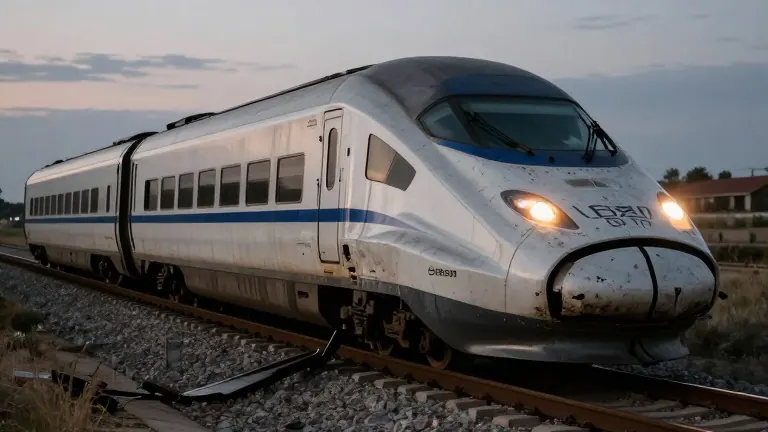
On Oct. 28, two trains collided near Urda, close to Toledo in central Spain, killing at least 69 people. Ten months earlier, a collision between two trains on the same line near Adamuz, close to Cordoba, killed 46 people. An initial investigation into the Adamuz crash found a broken rail caused one train to leave the line and enter the path of an oncoming train.
Gonalez said the crashes share a common thread: "Now we have seen three dreadful crashes in Spain, at Angrois, Adamuz and Urda. They will keep happening if we do not act." He added that the Angrois driver was going too fast, the Adamuz investigation found a track problem, and the Urda crash may have involved human error and a control system problem.
Santiago Rosendo, a passenger in the Renfe train at Adamuz, described the collision: "There was a sudden stop, a very sudden stop, then following that, a loud crash. Then the train moved from side to side until the train slid onto its side and we were left entirely in the dark." He added, "I cannot believe that this has happened again on the same line. We have to do something."
European Commission data shows that from 2018 to 2022, Spain spent an average of about $1.67bn each year on high-speed lines, more than other European countries with similar networks, but only 16 percent went to maintenance or repairs. Italy, Germany and France spent 33 to 39 percent of their budgets on maintenance during that period, though each operates a smaller network than Spain's 4,000km (2,485 miles).
Jose Maria Goicolea, spokesman for the Spanish Association of Civil Engineers, said the Madrid-Seville line uses a German-made LZB control system dating from the 1970s that is being phased out. He said he would close the line while the system is replaced. The line carried both crashes this year. About 40 million people used Spain's high-speed trains in 2024, almost double the 2019 figure.
Ramiro Aupin Lopera, an infrastructure expert at the University Politecnica de Catalunya, said maintenance investment fell after 2012 following the financial crisis even as network use grew. "It is no surprise that we have had two crashes in less than a year," he said. Diego Martin of SEMAF, the Spanish train drivers' union, said, "Blame does not prevent accidents; identifying and determining the causes does."