Moon Water May Run Dry for Big Towns
A new study says the moon cannot support large cities because it lacks enough water to keep them running for long.
By Carolina Wood ·
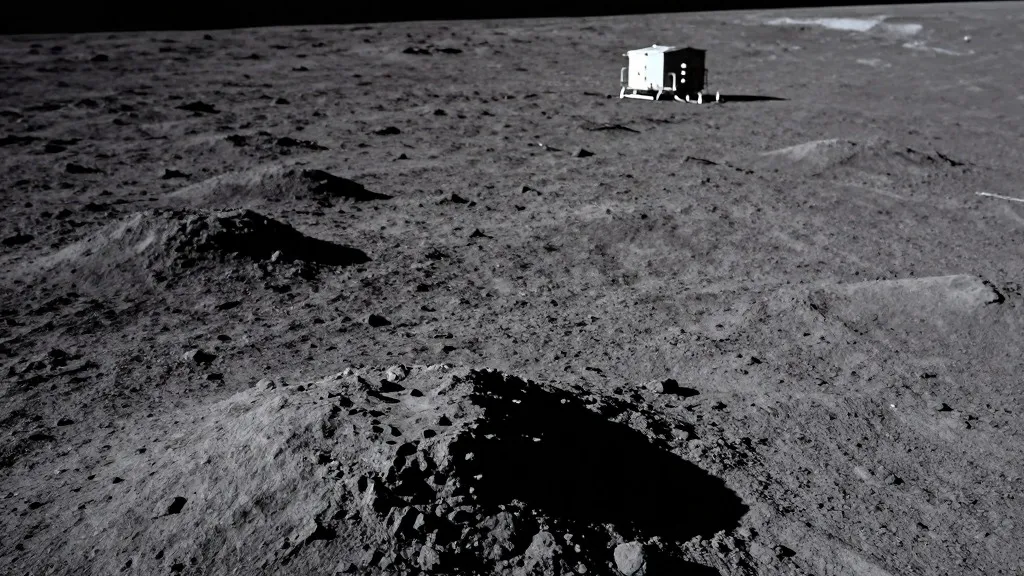
Plans to build big cities on the moon may hit a wall. A study released on October 24, 2026, says there is not enough water on the moon to sustain large populations for long. Researchers say the moon's resources can power a million people. However, they cannot provide water to keep them alive for more than a century.
The study looks at plans from major tech leaders. In February 2026, SpaceX CEO Elon Musk said his company would focus on building a self-growing city on the moon. He said this could happen in under 10 years. Blue Origin CEO Jeff Bezos has said millions of people will live in space by 2045.
Researchers decided to test these numbers. Martin Elvis, a senior astrophysicist at Harvard University's Smithsonian Astrophysical Observatory, worked with Jonathan McDowell of Durham University Space Research Centre. Their paper appears in the journal Frontiers in Space Technologies. It looks at two needs: power and water.
Power is not the problem. The researchers found that solar and nuclear energy could support one million people on the moon. Water is a different story. Water does exist on the moon, mostly in dark areas at the poles. The study assumes there is about one billion tonnes of it. This amount could support one million people for about 100 years. This assumes a recycling rate of 98 per cent, which matches the rate on the International Space Station.
The researchers say this amount is not large. Elvis compared the total to an aquarium the size of Central Park. He said it would be filled until the Statue of Liberty is underwater. He called it a small lake. A small lake cannot supply a big city for long.
Smaller towns could last longer. A town of 10,000 people could sustain itself for centuries. However, Elvis said the estimate of one billion tonnes is likely too high. He thinks the actual amount of water is much lower. He also said only part of the water can be recovered. If his estimates are correct, the 100-year supply could drop to one year.
There is also a question about the water's form. Gordon Osinski, a professor at Western University, said satellite measurements have errors. He wants to confirm the water exists on the ground. He said it could be like Arctic permafrost. It might be ice crystals mixed into soil that is hard to get out.
McDowell said the findings are not meant to stop the work. He said the truth is never negative. He added that trying something that will not work is negative.