Jordan mourns after deadly church funeral shooting
Seven people died and forty were injured when gunmen opened fire during a religious service in the town of Karak.
By Carolina Wood ·
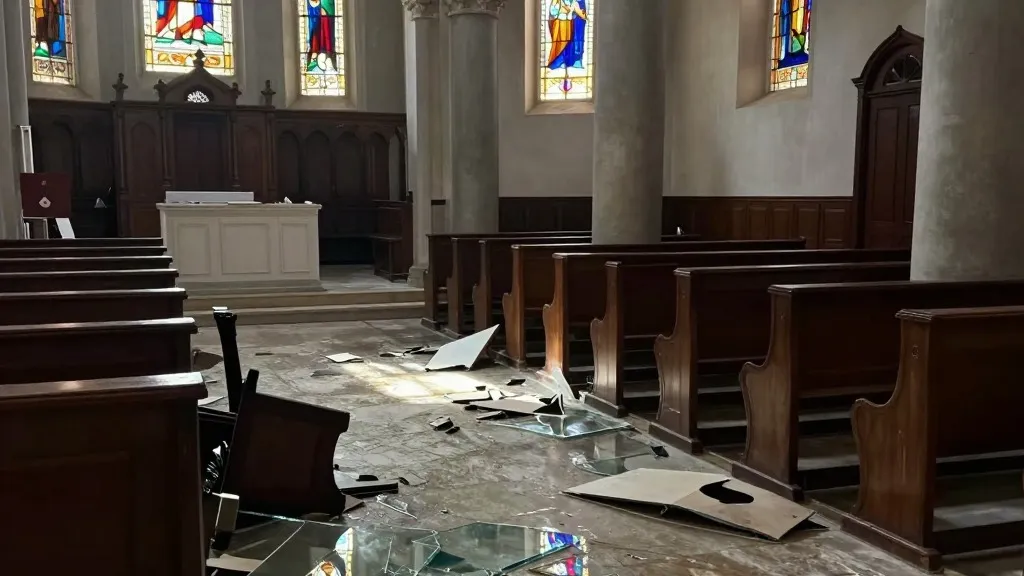
For residents of Karak, a town located roughly 55 miles south of Amman, the rhythm of daily life was disrupted this week by a sudden and violent breach of a place of worship. On Friday, gunmen attacked a Greek Orthodox church during a funeral service, resulting in the deaths of seven individuals and wounding forty others. The incident marks a significant escalation in violence for a community that has long been defined by its religious diversity and relative stability.
State television footage provided a clear view of the initial moments of the assault. Two men, appearing to be armed with pistols, were seen walking toward the church building while firing their weapons. A third individual, who appeared to carry a semiautomatic rifle, followed closely behind, adding to the volume of gunfire. The attackers then rushed toward the entrance of the church. Witness recordings captured the aftermath inside, showing shattered glass scattered across the floor and pools of blood near the altar.
The attack occurred approximately fifteen minutes after the funeral services had begun. Dorgham Halasa, who was present as a mourner, described the scene as chaotic and intense. He noted that people began to run immediately as the heavy gunfire started. While Halasa did not see the attackers with his own eyes, he reported that others in the crowd identified four individuals involved in the shooting. Security services have not yet confirmed the exact number of assailants, leaving some details of the operation unclear.
In the immediate aftermath, Jordanian authorities declared the attack to be the work of unknown assailants. The government stated that investigations were being conducted at full speed to determine the identities and motives of the shooters. As of the latest reports, it was not confirmed whether any of the gunmen had been captured or killed in the crossfire. To honor the victims, the kingdom declared three days of national mourning, a gesture that underscores the gravity of the event in the eyes of the public.
Health officials provided further details on the condition of the injured. Ibrahim al-Budour, the Minister of Health, confirmed that two of the forty wounded are currently in critical condition. The severity of the injuries highlights the close proximity of the shooters to the congregation, a factor that often complicates medical responses in such confined spaces.
The leadership of Jordan responded swiftly to the tragedy. King Abdullah II used the social media platform X to express the nation's resolve, stating that the country would confront the terrorist act with the harshest penalties available. He extended his deepest condolences to the families of the deceased and wished for the recovery of the wounded. Prime Minister Jafar Hassan, speaking at a security meeting in Karak on Friday evening, characterized the incident as a product of terrorist ideology and blind extremism. He emphasized that legal measures would be taken against those who seek to introduce such extremism into the region.
Karak is not new to deadly violence, as the town has experienced similar attacks in the past. In 2016, gunmen ambushed police in a series of coordinated strikes, including at a Crusader castle that is popular with tourists. That previous incident resulted in ten deaths, seven of whom were officers, and left dozens wounded. Security forces resolved that standoff by killing the gunmen after a prolonged engagement. The history of violence in the region adds a layer of context to the current investigation.
The attack drew immediate condemnation from across the Middle East and the international community. Leaders from Lebanon, Syria, Egypt, and Oman voiced their sorrow and support for Jordan. Ahmed al-Tayeb, the grand imam of Al-Azhar, the foremost religious institution in the Sunni Muslim world, called the shooting a heinous terrorist attack and offered condolences to the victims' families. Iraqi Foreign Minister Fuad Hussein also spoke with his Jordanian counterpart, affirming Iraq's solidarity with Jordan in the face of the threat.
The United Nations also weighed in on the tragedy. Secretary-General Antonio Guterres described the attack as especially heinous because it took place during a funeral, a time traditionally associated with peace and remembrance. According to his spokesman, Stephane Dujarric, the secretary-general called for all those responsible to be found and held to account. The international response reflects a shared concern over the safety of religious gatherings and the need for accountability in the region.
As Jordan moves forward, the focus remains on the ongoing investigation and the recovery of the wounded. The declaration of national mourning provides a period for reflection, but the questions surrounding the identity of the attackers and their ultimate goals remain central to the public discourse. The community of Karak, along with the rest of the nation, awaits further updates from security services as they work to bring the perpetrators to justice.