Tübingen study finds carrion crows reach visual decisions in 0.5 seconds
Neurobiologists say the birds use the same decision logic as primates but process visual motion data at twice the speed.
By Thomas Obasi ·
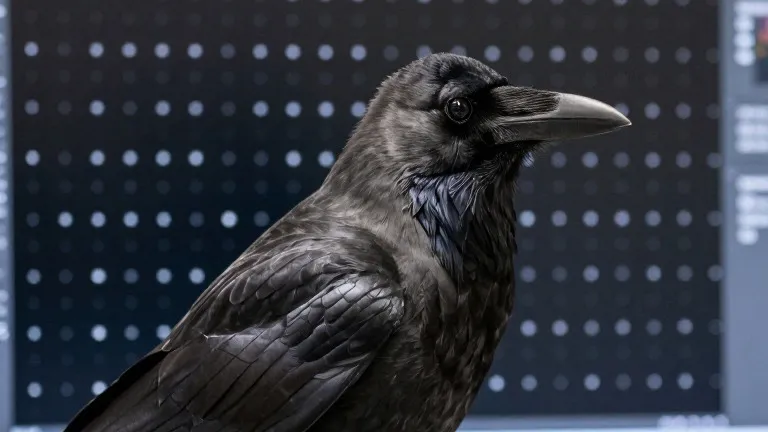
Carrion crows make visual decisions in half the time it takes primates, according to a new study from the University of Tübingen. The research shows that birds arrive at choices using the same mathematical logic as monkeys, despite having fundamentally different brain structures.
The team tested two hand-raised carrion crows on the random-dot-motion task. In this standard experiment, a cloud of flickering specks drifts weakly in a single direction. The subject must identify the direction of movement. In primates, this task reveals that neurons in the neocortex collect visual evidence over time. Their firing rates climb until they cross a threshold, triggering a committed choice.
Birds lack a neocortex, which created uncertainty about how their brains handle similar decisions. Andreas Nieder, a neurobiologist at the University of Tübingen, described this as the central question of the project. He asked how a differently organized avian brain would encode decisions.
Nieder and colleague Philipp Schmidbauer recorded brain activity while the crows worked. The birds sat before a touch-sensitive monitor displaying white dots on a black background. A fraction of the dots moved left, right, up, or down. The crows indicated the direction by pecking a target next to the screen. A correct response earned a mealworm.
The researchers kept the setup identical to the monkey version. Nieder noted that the only difference was the response method. Crows pecked to indicate their decision, while monkeys used eye movements. The team varied difficulty by changing the percentage of dots moving coherently. The easy condition used 81 percent coherent dots, while the hardest used 3 percent. They also included a condition with zero coherent dots, where no correct answer existed.
The crows solved the task using the same accumulation logic as primates. They reached their decisions twice as fast as monkeys do. The results show that a brain without a neocortex can process visual evidence and arrive at comparable decisions through a similar process.