Halley Dust Streaks Georgia Sky
A Toccoa photographer captured three bright meteors from the Orionid shower on Oct. 21 using a Canon EOS Ra.
By Carolina Wood ·
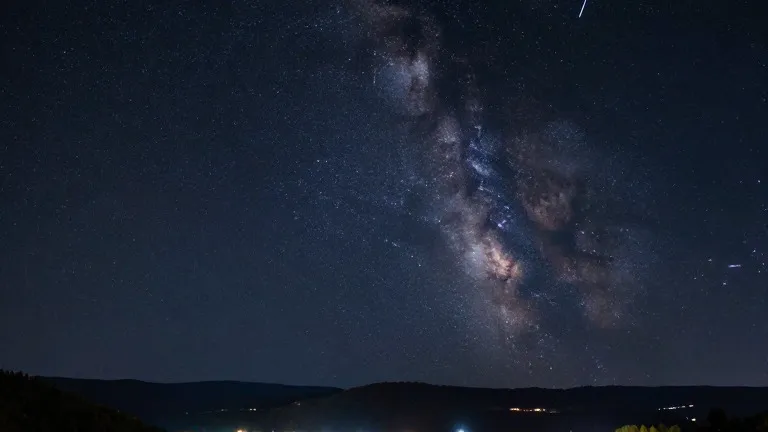
Tim McCollum photographed three bright meteors over Toccoa, Georgia, during the early morning hours of Oct. 21. The streaks resulted from debris shed by Comet 1P/Halley. Although the comet itself is more than 3 billion miles away, the particles left in its wake created glowing trails in the autumn sky.
McCollum recorded the events between 3 a.m. and 4 a.m. The meteors appear to radiate from a point near Betelgeuse, a red giant star in the constellation Orion. This origin point aligns with the radiant of the annual Orionid meteor shower, which was building toward peak activity at the time of the capture.
Capturing these transient objects requires specific equipment and patience. McCollum used a Canon EOS Ra camera paired with an RF 28-70 f2.0 lens. A star tracker kept the camera locked on the radiant while he shot multiple 30-second exposures. He later merged the individual frames into a single composite image using PixInsight software.
The final image contains more than just the meteor trails. The stars of Orion's Belt appear on the right side, adjacent to the glow of the Orion Nebula. The Rosette Nebula, known as Caldwell 49, is also visible within the starfield. Dense dust lanes of the Milky Way's galactic plane run diagonally across the background, hosting numerous star clusters.
Observers have until Nov. 7 to see the Orionid shower activity. The stream of debris from Halley's Comet continues to intersect with Earth's orbit during this period. Additionally, Earth is currently passing through debris from Comet 2P/Encke. This secondary stream produces the Taurid meteor shower, which can occasionally generate large fireballs around Halloween.
McCollum's photograph documents the activity two days before the source article's publication date. The image serves as a record of the debris field that remains active for local skywatchers. The combination of long-exposure photography and tracking technology allowed for the detailed capture of both the meteors and the surrounding deep sky objects.